Your Basket


When a customer is considering buying a bike or trike, one of the first questions they ask themselves is, “Is it comfortable?” Then comes “Will it still be comfortable in an hours’ time?” Sadly, the answer is usually, no. especially where those long rides in the countryside are concerned. The reason for this unfortunate truth is that bums are soft and have nerve endings and saddles are hard – sometimes very hard - and they don’t really care!
So, when we decided to redesign our current seat and backrest system (SBS) for our sport, leisure and touring customers, comfort was at the forefront of our minds. In fact, it was the whole purpose of the upgrade.
That’s not to say that our system wasn’t good; we just thought it could be better! I believe the seat and backrest combination we have created is the most comfortable and supportive, SBS available today, for reasons I will explain, but to make sense of it all, I first need to explain why sitting on a seat or saddle for long periods can be so uncomfortable and for that we need to know a little bit about our bums.
When we sit on any surface but particularly, a relatively hard surface like a bike saddle, most of your body weight is supported by the ischium; the two lower blades of the back of the hip bone, often called the "sit bones".
The Sit bones are sheathed by the Gluteus muscles; (predominantly the gluteus maximus, which is the biggest of the group of three that form your buttocks) and these provide padding between your sit bones and the surface you are sitting on. However, because the sit bones are curved and not flat, the whole weight of the body is concentrated on a very small area which can put a lot of compressive pressure on the “Glutes”, as they are collectively called.
You can discover the position of these contact points for yourself, by spreading a sheet of corrugated cardboard on a hard flat surface like a bench; sitting on it, then wriggling your bum by pretending to cycle. You will see two distinct depressions in the cardboard, about the size of a golf ball and about 10cm apart. When you cycle, most of your body weight is supported on those small areas which severely compresses the gluteus muscles. No wonder cycling becomes painful!

Sitting on a hard seat or saddle, or falling into potholes, can cause compression, not only of the glutes, but also the nerves that traverse the groin and legs. This can result in a condition called pudendal nerve irritation which causes “perineal pain”. (pain between the genitals and anus). Cycling, is often cited as a cause of Pudendal nerve irritation and it even has its own name – “Cyclists Syndrome”.
As if that’s not enough, compression of the buttocks can cause Piriformis syndrome, a condition where the piriformis muscle in the buttock compresses the sciatic nerve, causes pain, tingling, or numbness deep within the buttock, often radiating down the back of the thigh, similar to sciatica.
You could be forgiven for wondering why bike and trike seats aren’t made more comfortable to overcome these issues, and for the answer, we need to go back to the birth of man when there were no bikes or trikes. Of necessity, mankind developed the ability to run very fast in an upright manner, either to catch their dinner, or to avoid being dinner themselves. So, evolution called the shots and bikes and trikes had to develop with the rider’s legs in a more or less upright position to get the most efficiency from the human body.
Unfortunately, this means that a bike saddle has to be cut away on the flanks to allow the legs to hang down towards the pedals and to allow the cycling movements. The supportive back of the saddle is generally kept narrow, particularly on racing or performance bikes so as not to restrict rolling movement of the pelvis and buttocks. Such saddles are generally only an inch wider than the spacing between the pressure points on the “sit bones” It all adds up to a very narrow support if you are thinking of riding any distance.
There are many hundreds of bike saddles of all shapes and sizes and body contours, each with their own claim of better performance in some way or another, but the truth is that they all support a lot of weight, over a small area, on a very hard surface, and the human body doesn’t like it!
Because to the best of my knowledge, no-one has ever suffered Cyclist Syndrome from sitting in an easy chair, we thought a tricycle compatible cushioned seat, not unlike an easy chair was a good place to start. Of course, it would be different in many ways but that was the original premise.
We designed our innovative cushion seat to be wide enough to support the hips as well as the sit bones. This would spread the weight of the rider over a far greater area and reduce the pressure on the two sit-bone pressure points, to approximately a fortieth of the pressure created by a conventional saddle!
Such a large seat is practical with the inherent stability of a trike, but would be positively destabilizing on a bicycle; so a trike is really the only choice for a really comfortable ride, even if you are happy to ride a bicycle.
That all sounds great but there is a caveat! With a large, flat seat, the trike cannot be built to the conventional “upright” trike geometry. It must be low sitting with the legs stretched out in front. This reduces cycling efficiency by a small amount and can be prohibitive in rare cases of muscular problems or hip range, but for most people there are no problems and an electric drive can compensate for any slight power loss. (See our Flame Trike).
To give the cushion the natural bolster that gives lateral support when cornering or on cambers, we designed a curved base for the seat. We covered its underside with an ABS plastic molded closure to make the seat storm proof and tidy in appearance when the SBS is removed for transport.
An important part of the seat design was the cushion position. Too far back relative to the backrest and the cushion effect would push the bum forward. Too far forward and the front edge of the cushion would pressurize the hamstrings (thigh muscles), making cycling uncomfortable and reducing leg stretch. Consequently, we made the seat position adjustable and available in different lengths.
Next came the cushion foam. There are many different density grades, and we would need different densities for different parts of the cushion to give different degrees of support. The problem with the “hard” bicycle seat, is that apart from some profiling, it relies entirely on the glutes to absorb the weight of the rider and any jolts and shocks induced by potholes and other uneven surfaces.
More desirable is a cushion material that is similar or just a little more supportive than the glutes, the reason being that the glutes and cushion foam will share the rider’s weight evenly during normal cycling, with plenty of “cushioning-effect” left over when encountering the inevitable pothole. The SBS may jolt, but it should never jar.
Though we need the cushion foam to be fully supportive, we did not want it to be bouncy, as this would compromise safety. Memory foam would act as a damper or shock absorber, but proved to be too sluggish in recovery, so we opted instead for an open structure foam that would “exhale” when being compressed and “inhale” when being relaxed.
We than covered the cushion in “waterproof “closed cell foam”, with a nylon coating for strength and durability. This creates an air cushion for the rider by trapping the air within the cushion. It follows that by controlling venting of the air in both directions, we would be able to regulate the speed at which the cushion would deform then recover during the various movements of the pedaling cycle. With the vents hidden beneath the base molding we were able to achieve a near perfect result that was still storm and splashproof.
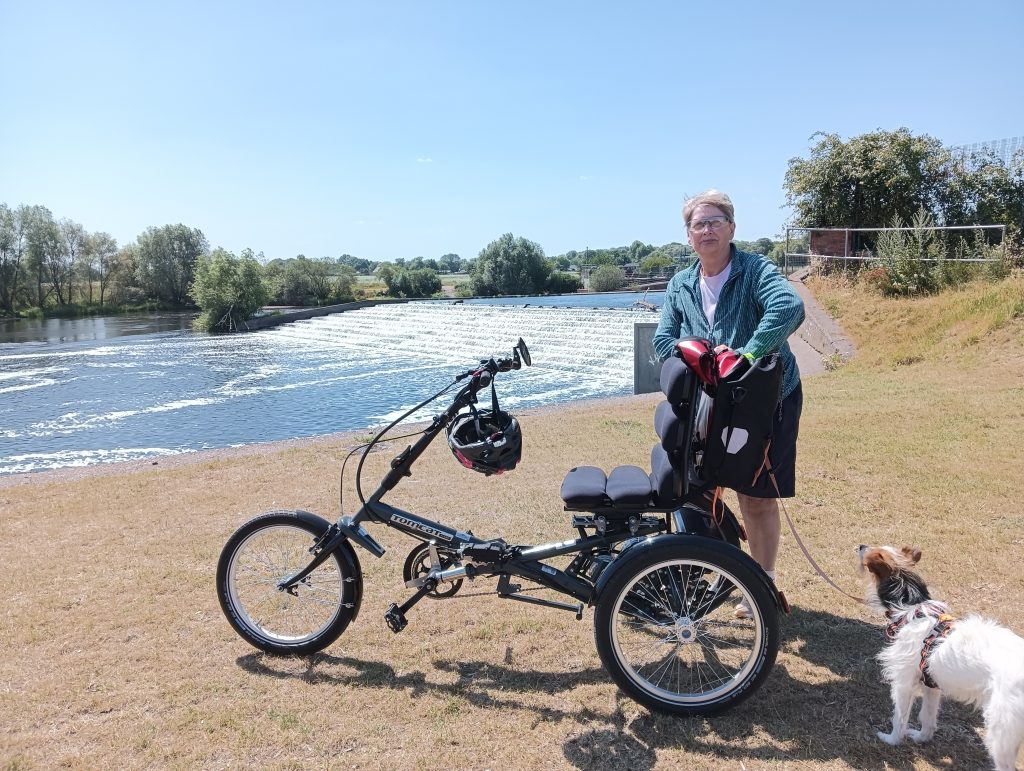
To compliment the seat, we chose a mesh backrest. Though originally designed for high-end chairs, they are ideal for trike backrests providing you need no extra lateral support or head support. The shape of the frame creates a natural bolster effect, giving perfect lateral support, and at the same time, very cleverly contours the mesh to the general lumber shape of the adult spine.
Because Tomcat is famous for the transportability of our trikes, we needed the new ensemble to be equally transportable and spanner free, so not only does the seat remove from the trike at the pull of a lever, the backrest detaches from the seat too, this time with the pull of a plunger.
We think the Comfort seat is the greatest advance in cycling comfort since the sprung saddle and to put it to the test we invited our staff, visitors and customers to try it out for themselves at every opportunity.
The feedback has been positive in every case but one of our reps (who never calls a spade a horticultural implement), walked into my office, put his hand on my shoulder and said, “Got it right first time there Bob”.
I didn’t trouble him with the number of attempts we’d had at getting it right first time!
Blog
Bike life blog
Keep on triking


For many riders, cycling isn’t about big distances or one-off

Short answer: yes — many people do. Longer answer: cycling
Choosing — and riding — an adult trike doesn’t start